TB-500 Research Review 2026: Latest Studies, Wound Healing Research & FDA Update

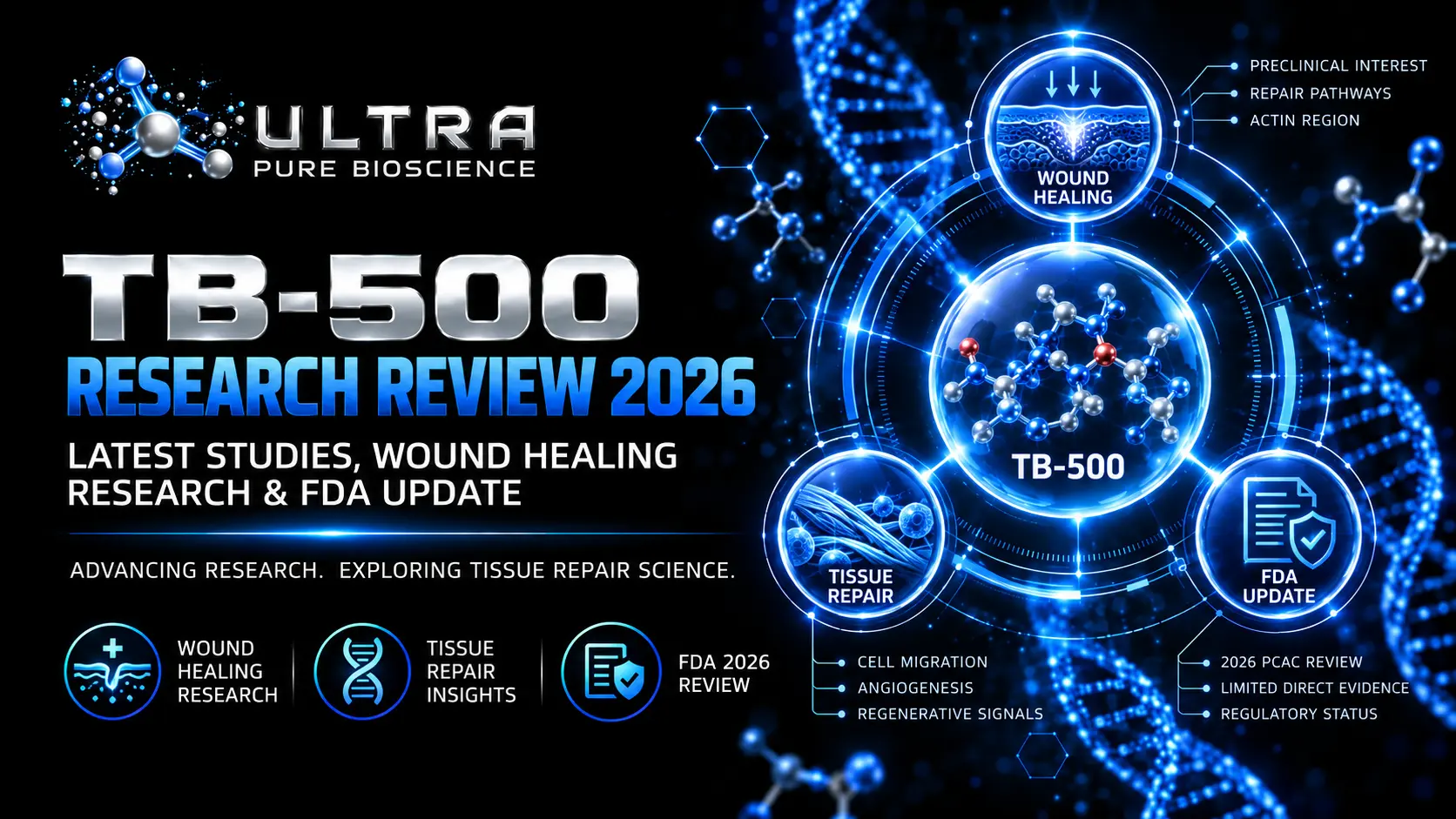
TB-500 Research Review has become especially relevant in 2026 because scientists and U.S. regulators are taking a closer look at what TB-500 actually is, how it differs from thymosin beta-4, and how much direct evidence exists for the peptide itself.
TB-500 is commonly discussed in connection with wound healing, tissue repair, angiogenesis, tendons, muscles, and inflammation. However, much of the published research often cited online involves full-length thymosin beta-4 rather than TB-500 itself.
That difference is critical.
The U.S. Food and Drug Administration reviewed TB-500 in detail in 2026. FDA identified TB-500 as an N-acetylated seven-amino-acid fragment of thymosin beta-4 and reported that it had not identified published clinical studies or human exposure data for TB-500 through any route of administration.
This TB-500 Research Review separates research on the TB-500 fragment from studies involving the much larger thymosin beta-4 molecule. It also reviews the latest FDA findings, biological mechanisms, safety questions, wound-healing research, and regulatory status.
Research Notice: This article is for scientific and educational purposes only. Ultra Pure Bioscience research materials are intended strictly for laboratory and analytical research. They are not intended for human or veterinary use, diagnosis, treatment, or prevention of disease.
TB-500 Research Review: What Is TB-500?
TB-500 is a synthetic peptide fragment related to thymosin beta-4.
According to FDA’s July 2026 scientific review, TB-500 is the N-acetylated heptapeptide N-acetyl-LKKTETQ.
In simpler terms, TB-500 contains seven amino acids.
FDA also notes that the sequence includes the LKKTET actin-binding region associated with full-length thymosin beta-4. This region has been proposed as one possible contributor to the biological activity studied with thymosin beta-4.
However, sharing part of a sequence does not mean that TB-500 and thymosin beta-4 have identical biological effects.
Their size, structure, metabolism, and behavior can differ.
That distinction should remain clear throughout any TB-500 research discussion.
Is TB-500 the Same as Thymosin Beta-4?
No.
This is one of the most important points in any TB-500 Research Review.
Full-length thymosin beta-4 is a naturally occurring peptide containing 43 amino acids. Researchers have studied it for decades in relation to actin binding, cell migration, angiogenesis, wound repair, inflammation, and tissue protection.
TB-500 is much smaller.
FDA describes it as a seven-amino-acid synthetic fragment derived from thymosin beta-4 amino acids 17 through 23, with an acetyl group at the N-terminus.
Therefore:
| Compound | Structure | Evidence base |
|---|---|---|
| Thymosin beta-4 | Full-length 43-amino-acid peptide | Large preclinical literature + some clinical research |
| TB-500 | Seven-amino-acid synthetic fragment | Very limited direct evidence |
| Relationship | TB-500 contains part of the Tβ4 sequence | Findings cannot automatically be transferred between them |
This distinction is especially important because many websites use the two names almost interchangeably.
Scientifically, they should not be treated as identical.
Why TB-500 Research Review Is Important in 2026
The year 2026 produced a major regulatory development.
On July 23, 2026, FDA’s Pharmacy Compounding Advisory Committee reviewed TB-500 free base and TB-500 acetate for possible inclusion on the Section 503A bulk drug substances list.
FDA evaluated TB-500 specifically for wound healing.
The advisory committee later voted 8 in favor, 6 against, with 1 abstention to recommend inclusion of TB-500. However, the committee’s recommendation is advisory and does not itself constitute FDA approval or automatically place TB-500 on the 503A list.
This makes 2026 a particularly important year for TB-500 research.
At the same time, FDA scientists raised major concerns about the lack of direct evidence.
What Did the FDA Find About TB-500 Research?
FDA’s 2026 review provides one of the clearest summaries of the direct TB-500 evidence.
The agency reported that it did not identify published human clinical studies in which TB-500 had been administered to treat a disease or condition.
FDA also stated that it had not identified published nonclinical in-vivo wound studies for TB-500 itself.
In addition, the FDA review discussed a 2024 laboratory study in which TB-500 did not promote closure in a fibroblast scratch-wound assay at the tested concentration.
Therefore, direct evidence for TB-500 is much more limited than many online summaries suggest.
This does not mean that TB-500 has no biological activity.
Rather, it means that the existing evidence is currently too limited to support strong conclusions about effectiveness in humans.
TB-500 and the Actin-Binding Region
One scientific reason for interest in TB-500 involves actin.
Actin is a structural protein that helps cells maintain shape and move.
Full-length thymosin beta-4 is well known as an actin-sequestering peptide. Researchers have studied its effects on cell movement, migration, tissue repair, and vascular biology.
TB-500 contains the sequence LKKTET, which lies within the actin-binding region of thymosin beta-4.
FDA notes that this region has been proposed as one contributor to wound-related activity associated with the full peptide.
However, the presence of this sequence does not prove that TB-500 reproduces every action of the complete thymosin beta-4 molecule.
Researchers still need direct experiments.
TB-500 Research and Wound Healing
Wound healing is probably the most discussed topic in TB-500 research.
However, this area requires careful interpretation.
Full-length thymosin beta-4 has produced substantial preclinical evidence related to wound repair.
For example, animal studies have reported increased re-epithelialization, collagen deposition, angiogenesis, and keratinocyte migration with thymosin beta-4.
Reviews have also described thymosin beta-4 activity in dermal repair and chronic-wound research.
But these are thymosin beta-4 studies, not automatically TB-500 studies.
FDA’s 2026 review specifically concluded that there was insufficient evidence to evaluate TB-500 itself for wound healing.
Therefore, the scientifically accurate conclusion is:
Full-length thymosin beta-4 has meaningful wound-repair research, while direct TB-500 wound-healing evidence remains limited.
TB-500 and Cell Migration Research
Cell migration is essential for many biological processes.
During tissue repair, cells move into damaged areas and help rebuild tissue.
Thymosin beta-4 has been linked to increased migration of endothelial cells, keratinocytes, and other cell types in experimental models.
This has led researchers to examine whether smaller fragments of thymosin beta-4 may preserve some related activity.
TB-500 contains part of the region associated with actin interactions.
However, direct TB-500 studies remain sparse.
Therefore, cell-migration mechanisms derived from full-length thymosin beta-4 should be described as related research, not proof of TB-500 activity.
TB-500 Research and Angiogenesis
Angiogenesis means the formation of new blood vessels.
It plays an important role in tissue development and wound repair.
Full-length thymosin beta-4 has repeatedly shown angiogenic activity in preclinical models. Researchers have reported endothelial-cell migration, blood-vessel formation, and vascular remodeling.
These findings partly explain why TB-500 became associated with tissue-repair research.
However, direct evidence showing that TB-500 produces the same angiogenic effects remains limited.
The two compounds should not be treated as interchangeable.
TB-500 and Tendon, Ligament, and Muscle Research
Online discussions often describe TB-500 in relation to tendon, ligament, or muscle repair.
However, direct published human evidence does not support strong claims in these areas.
FDA’s 2026 evaluation found no human clinical studies involving TB-500 administration for disease treatment or wound repair.
Some proposed mechanisms come from thymosin beta-4 biology, particularly actin regulation, cell migration, vascular development, and extracellular matrix remodeling.
Those mechanisms are scientifically relevant.
Still, researchers should distinguish a plausible mechanism from demonstrated effectiveness.
For TB-500 specifically, much more direct research is required.
Full-Length Thymosin Beta-4 Research
Although TB-500 evidence remains limited, research on full-length thymosin beta-4 is broader.
Studies have examined thymosin beta-4 in:
cell migration, wound repair, vascular biology, inflammation, fibrosis, tissue protection, cardiac injury, corneal repair, and other experimental systems.
A 2022 review described thymosin beta-4 as having angiogenic, anti-inflammatory, anti-apoptotic, and anti-fibrotic activity in wound-repair research.
Research also continues in 2026.
For example, a January 2026 review examined thymosin beta-4 in kidney-disease research.
An August 2026 preclinical study also examined thymosin beta-4 in sepsis-associated acute kidney injury and MAPK signaling.
Again, these studies involve full-length thymosin beta-4, not TB-500.
That distinction strengthens the scientific accuracy of this TB-500 Research Review.
What Is Known About TB-500 Pharmacokinetics?
Human pharmacokinetic data are lacking.
FDA reported that it did not identify published clinical pharmacokinetic studies for TB-500 in humans.
Animal research has provided some limited information.
In horses, FDA reported that TB-500 entered systemic circulation and later declined below measurable levels. Research also suggests that TB-500 can break down into shorter peptide fragments.
However, animal pharmacokinetics should not be used to predict human exposure directly.
Species differences can affect peptide metabolism, distribution, and clearance.
TB-500 Research Review: Safety Evidence
Safety is one of the biggest gaps in current TB-500 Research Review evidence.
FDA stated in 2026 that it had not identified human exposure data for TB-500 and that potential human safety risks remain unknown.
The agency also raised concerns about possible immunogenicity, aggregation, and peptide-related impurities.
FDA noted that peptides administered by certain routes may trigger immune responses, particularly when aggregation or impurities are present.
FDA’s search found no TB-500 adverse-event reports in the databases it reviewed.
However, the agency explicitly warned that the absence of reports does not prove safety because adverse-event reporting systems are incomplete.
Therefore, current TB-500 safety evidence remains insufficient for firm conclusions.
Is TB-500 FDA Approved?
No.
Neither TB-500 free base nor TB-500 acetate is a component of an FDA-approved drug.
FDA also reported that there is no applicable USP or National Formulary drug-substance monograph for either form.
In July 2026, the Pharmacy Compounding Advisory Committee recommended that TB-500 be considered for inclusion on the 503A bulk substances list.
However, advisory committee recommendations are non-binding.
They do not equal FDA approval.
As of this September 2026 review, the FDA materials continue to describe TB-500 as a substance under consideration rather than an FDA-approved drug.
What Did the July 2026 FDA Committee Vote Mean?
The July 23, 2026 vote created confusion online.
The committee supported adding TB-500 to the 503A bulks list by a vote of 8–6 with one abstention.
However, this did not mean that FDA approved TB-500.
It also did not establish that TB-500 is safe or effective.
Instead, the vote was a recommendation to FDA regarding compounding policy.
FDA retains the authority to make the final regulatory decision.
This distinction is essential when interpreting 2026 TB-500 news.
Is TB-500 Prohibited in Competitive Sport?
Yes.
The World Anti-Doping Agency classifies thymosin beta-4 and derivatives such as TB-500 under S2.3 Growth Factors and Growth Factor Modulators.
WADA’s 2026 laboratory technical document also specifically lists TB-500 under the prohibited S2.3 category.
Therefore, athletes subject to WADA rules should consider TB-500 a prohibited substance.
This is a sports-regulation issue and is separate from FDA drug approval.
TB-500 vs Thymosin Beta-4 Evidence
The most useful way to understand current research is to separate the two evidence bases.
| Research topic | Full thymosin beta-4 | TB-500 fragment |
|---|---|---|
| Actin biology | Strong mechanistic evidence | Sequence contains actin-related region |
| Cell migration | Substantial preclinical evidence | Limited direct evidence |
| Angiogenesis | Strong preclinical evidence | Limited direct evidence |
| Wound repair | Animal studies + some clinical work | FDA found insufficient direct evidence |
| Human exposure data | Some clinical research | FDA found no published human exposure studies |
| Human safety | Limited but studied | Unknown |
| 2026 FDA review | Not the main substance reviewed | Directly reviewed |
| FDA-approved drug | No general TB-4 approval established here | Not FDA approved |
The table shows why careful terminology matters.
It is scientifically inaccurate to treat every thymosin beta-4 paper as direct evidence for TB-500.
Why Research Material Quality Matters
Reliable peptide research depends on more than the compound name.
Identity, purity, analytical testing, batch traceability, storage conditions, and documentation can all affect experimental results.
This issue is especially relevant to TB-500 because FDA has noted inconsistent naming and chemical descriptions across commercially available substances using the TB-500 name.
Researchers can explore the Ultra Pure Bioscience research collection here:
Ultra Pure Bioscience Research Peptides
The dedicated laboratory listing for TB-500 is available here:
Ultra Pure Bioscience TB-500 Research Material
Ultra Pure Bioscience identifies these products as non-compounded research-use materials and states that they are not intended for human or veterinary use.
Future of TB-500 Research Review
The future of TB-500 Research Review will depend on direct research rather than inference from thymosin beta-4.
Scientists need better information on TB-500 itself.
That includes its molecular targets, stability, metabolism, cell effects, in-vivo activity, safety, immunogenicity, and possible differences between free-base and acetate forms.
Human clinical evidence would also be required before researchers could make reliable conclusions about effectiveness or safety.
The 2026 FDA review makes this evidence gap very clear.
For now, the strongest scientific approach is to separate established thymosin beta-4 biology from claims about the smaller TB-500 fragment.
TB-500 Research Review 2026: Key Findings
This TB-500 Research Review supports several clear conclusions:
- TB-500 is a seven-amino-acid synthetic fragment related to thymosin beta-4, not the full 43-amino-acid molecule.
- Full-length thymosin beta-4 has a much larger research literature involving actin biology, cell migration, angiogenesis, and tissue repair.
- FDA found no published human clinical studies or human exposure data for TB-500 itself.
- FDA also found insufficient direct evidence to evaluate TB-500 for wound healing.
- Human safety remains unknown, and FDA has raised concerns about immunogenicity, aggregation, and peptide impurities.
- The July 2026 FDA advisory panel recommended TB-500 for possible inclusion on the 503A bulks list, but that recommendation did not constitute FDA approval.
- WADA prohibits thymosin beta-4 and derivatives such as TB-500 in sport.
Overall, TB-500 remains a scientifically interesting but poorly characterized research fragment.
The most important research need is now direct evidence on TB-500 itself.
Frequently Asked Questions About TB-500 Research
What is TB-500?
TB-500 is an N-acetylated seven-amino-acid peptide fragment related to thymosin beta-4. FDA identifies its sequence as N-acetyl-LKKTETQ.
Is TB-500 the same as thymosin beta-4?
No.
Full-length thymosin beta-4 contains 43 amino acids, while TB-500 is a much smaller synthetic fragment.
What is TB-500 studied for?
TB-500 has been discussed mainly in relation to wound healing and tissue-repair mechanisms.
However, FDA reported in 2026 that direct evidence for TB-500 itself remains very limited.
Are there human studies on TB-500?
FDA stated in its 2026 review that it had not identified published clinical studies or human exposure data involving TB-500.
Does TB-500 heal tendons or muscles?
Current published human evidence is insufficient to establish that claim.
Many mechanistic ideas come from full-length thymosin beta-4 research rather than direct TB-500 trials.
Is TB-500 FDA approved?
No.
TB-500 is not a component of an FDA-approved drug.
Did FDA approve TB-500 in July 2026?
No.
An FDA advisory committee recommended inclusion on the 503A bulks list, but the vote was advisory and was not FDA drug approval.
Is TB-500 banned in sports?
Yes.
WADA lists thymosin beta-4 and derivatives such as TB-500 as prohibited under its growth-factor category.
Scientific sources to link in WordPress
For strong E-E-A-T and outbound-link signals, use these authoritative sources naturally inside the article:
FDA 2026 TB-500 scientific briefing document
FDA July 2026 Pharmacy Compounding Advisory Committee meeting
PubMed — Thymosin beta-4 and angiogenesis review
PubMed — Thymosin beta-4 wound-healing research
WADA — TB-500 scientific and anti-doping resources