Bacteriostatic Water for Research: What Labs Actually Check

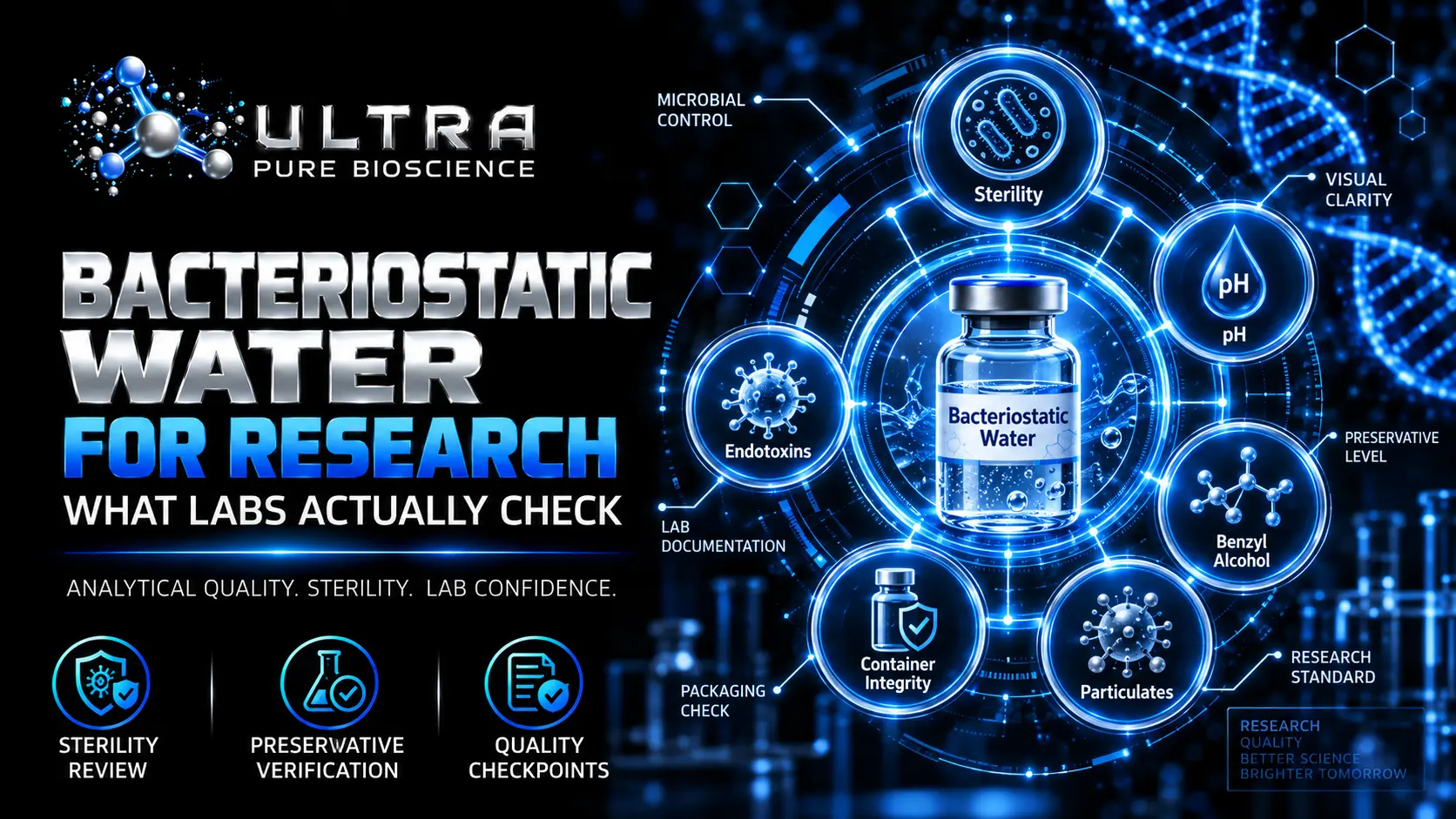
Bacteriostatic water for research is not verified by a clear vial. Laboratories measure benzyl alcohol, confirm identity, record pH, screen endotoxin, and document sterility against a lot number. If those results are missing, the solvent is undocumented.
This guide explains the checks that belong on a real Certificate of Analysis, how to read them, and how Ultra Pure Bioscience documents bacteriostatic water for research. All Ultra Pure Bioscience products are intended strictly for laboratory, analytical, and scientific use. They are not for human or veterinary use, injection, infusion, or any clinical application.
[Insert image 1 here]
Alt: bacteriostatic water for research vial beside a certificate of analysis
Caption: A research vial is only as useful as the lot-matched test report next to it.
What bacteriostatic water for research contains
Standard bacteriostatic water for research is sterile water plus a labeled preservative. In the United States, the usual formula is:
- Sterile water for injection as the vehicle
- Benzyl alcohol at 0.9% w/v (9 mg/mL), sometimes 1.1%
- Target pH near 5.7, acceptable range 4.5 to 7.0
- No salts and no buffers in the basic formula
Benzyl alcohol is bacteriostatic. It slows bacterial growth after a needle enters a multi-dose vial. It does not sterilize a contaminated container, and it does not destroy bacterial endotoxin. Those limits are why labs test more than appearance.
The six lab checks that matter
[Insert image 2 here]
Alt: lab checks used for bacteriostatic water for research including assay pH endotoxin and sterility
Caption: A complete panel covers assay, identity, pH, endotoxin, sterility, and appearance.
1. Benzyl alcohol assay
This is the defining test for bacteriostatic water for research. Labs quantify benzyl alcohol by gas chromatography or HPLC-UV. Typical acceptance is about 90.0% to 110.0% of label claim. For a 0.9% product, that is roughly 8.1 to 9.9 mg/mL.
The same run can flag benzaldehyde, an oxidation impurity that appears after heat or light stress. A report that only says “contains preservative” is not an assay. Demand a number, a method, a specification, and a pass or fail.
2. Identity confirmation
Assay answers how much. Identity answers of what. Common methods are GC retention time versus a standard or LC-MS confirmation, plus a visual check that the liquid is clear and colorless. Without identity, sterile water or saline can be sold under the wrong name.
3. pH
The usual range is 4.5 to 7.0, often measured per USP ⟨791⟩. Finished lots commonly land around 5.5 to 5.7. pH supports preservative stability and tells you whether the lot still matches the labeled solvent after storage.
4. Bacterial endotoxin
Endotoxin is lipopolysaccharide from Gram-negative bacteria. It can remain after organisms are removed. The USP-style limit for this product class is less than 0.5 EU/mL, usually by USP ⟨85⟩ (LAL). A sterility pass does not replace this screen.
5. Sterility or microbial screen
Sterility testing follows USP ⟨71⟩ or a validated equivalent. Classic incubation is 14 days with a “no growth” criterion. Rapid methods can supplement that work, but the report must still name the method. The preservative does not make a non-sterile fill sterile.
6. Appearance and particles
Reject haze, fibers, or floating specks. Compendial products also face subvisible particle limits. In a research lab, visible contamination is enough to stop use of that vial.
How to read the COA
[Insert image 3 here]
Alt: certificate of analysis tests for bacteriostatic water used in research labs
Caption: Match lot number, method, specification, result, lab name, and test date.
Use this checklist before a vial enters a protocol:
| Check | What it should show | Red flag |
|---|---|---|
| Product name | Bacteriostatic water, not generic water | Vague name |
| Lot number | Matches the vial | Recycled PDF |
| Test date | Dated and current | Blank date |
| Lab name | Identifiable laboratory | Anonymous QC only |
| Benzyl alcohol assay | About 0.9% or 1.1%, with method | No number |
| Identity | GC, LC-MS, or equivalent | Missing |
| pH | 4.5–7.0 | Missing |
| Endotoxin | Below 0.5 EU/mL | Omitted |
| Sterility | No growth, method named | “Filtered” used as proof |
| Appearance | Clear and colorless | Cloudiness ignored |
If the lot on the PDF does not match the lot on the vial, the document does not describe the bottle in your hand.
Bacteriostatic water for research vs sterile water
[Insert image 4 here]
Alt: bacteriostatic water for research compared with sterile water vials
Caption: The preservative is the functional difference, not a purity slogan.
| Diluent | Preservative | Typical lab use | After first puncture |
|---|---|---|---|
| Bacteriostatic water | 0.9% benzyl alcohol | Multi-withdrawal reconstitution of compatible compounds | Designed for repeated entry in a controlled workflow |
| Sterile water | None | Single-entry work when a preservative is unwanted | Treat as single use |
| 0.9% sodium chloride | Usually none | Work that needs ionic strength | Not interchangeable |
| Distilled or bottled water | None | Not a research reconstitution solvent | Do not use |
Some peptides and assays are studied in preservative-free water because benzyl alcohol can interfere with a sequence or a method. The protocol decides the solvent. Bacteriostatic water for research is a different reagent from sterile water, not a stronger version of it.
Phrases that are not lab data
These claims do not replace a test panel:
- Lab grade
- Ultra pure
- Pharmaceutical quality
- Filtered
- Good for peptides
HPLC purity is the headline test for a lyophilized peptide. It is the wrong headline for water. If a vendor posts a 99% HPLC figure and no benzyl alcohol assay, the template was copied from a peptide page.
How Ultra Pure Bioscience documents this solvent
Ultra Pure Bioscience sells bacteriostatic water for research as a laboratory aqueous solution for controlled research environments. Published product details include:
- 0.9% (9 mg/mL) benzyl alcohol
- pH controlled between 4.5 and 7.0, with listed lots around 5.5 to 5.7
- Benzyl alcohol assay by GC
- Identity confirmation by LC-MS
- Endotoxin screen
- Microbial sterility screen
Review the lot documents in the product gallery before use. Lyophilized research compounds arrive as dry powder. The diluent is a separate SKU with its own panel.
Add a button here to the product page. Use anchor text such as View UPB Bac Water 30 mL. Do not use the focus keyphrase as the link text. Yoast flags that as a competing link.
Handling after the vial is opened
Testing describes the unopened lot. Technique decides what happens after the stopper is entered.
- Inspect the vial. Discard discoloration, cloudiness, or particles.
- Use aseptic technique. The preservative is not a substitute for clean handling.
- Write the first-entry date on the label.
- Follow the labeled in-use window. Many multi-dose labels use about 28 days after first puncture.
- Do not pool leftover solvent from different lots.
- Keep the COA with the lot record.
Bottom line
Bacteriostatic water for research is qualified by assay, identity, pH, endotoxin, and sterility. A clear liquid is not a specification. Read the COA the same way you would read a peptide report: method, specification, result, date, lab, and lot match.
Ultra Pure Bioscience products are for laboratory research use only. They are not intended to diagnose, treat, cure, or prevent any disease.
Need documented bacteriostatic water for laboratory reconstitution?
Review the lot panel for benzyl alcohol assay, identity, endotoxin, and sterility, then add the matching diluent to your research order.
For laboratory research use only. Not for human or veterinary use.
Frequently asked questions
What do labs test in bacteriostatic water for research?
They test benzyl alcohol content, identity, pH, bacterial endotoxin, sterility, and appearance on a specific lot.
How much benzyl alcohol should it contain?
The standard labeled strength is 0.9% w/v, or 9 mg/mL. Some presentations use 1.1%. The assay should fall inside the stated specification.
Is it the same as sterile water?
No. Sterile water has no preservative and is handled as single-entry material. Bacteriostatic water for research contains benzyl alcohol so a multi-dose vial can be entered more than once under controlled conditions.
Does a sterility pass mean the water is endotoxin-free?
No. Endotoxin can remain after organisms are killed or removed. Ask for a separate endotoxin result.
Can every research peptide use this diluent?
Not automatically. Some protocols specify preservative-free water. Follow the research protocol.
Are Ultra Pure Bioscience products for human use?
No. They are intended strictly for research, laboratory, and analytical purposes only.