GHK-Cu Peptide Research 2026: Latest Studies on Skin, Collagen, Hair & Tissue Repair

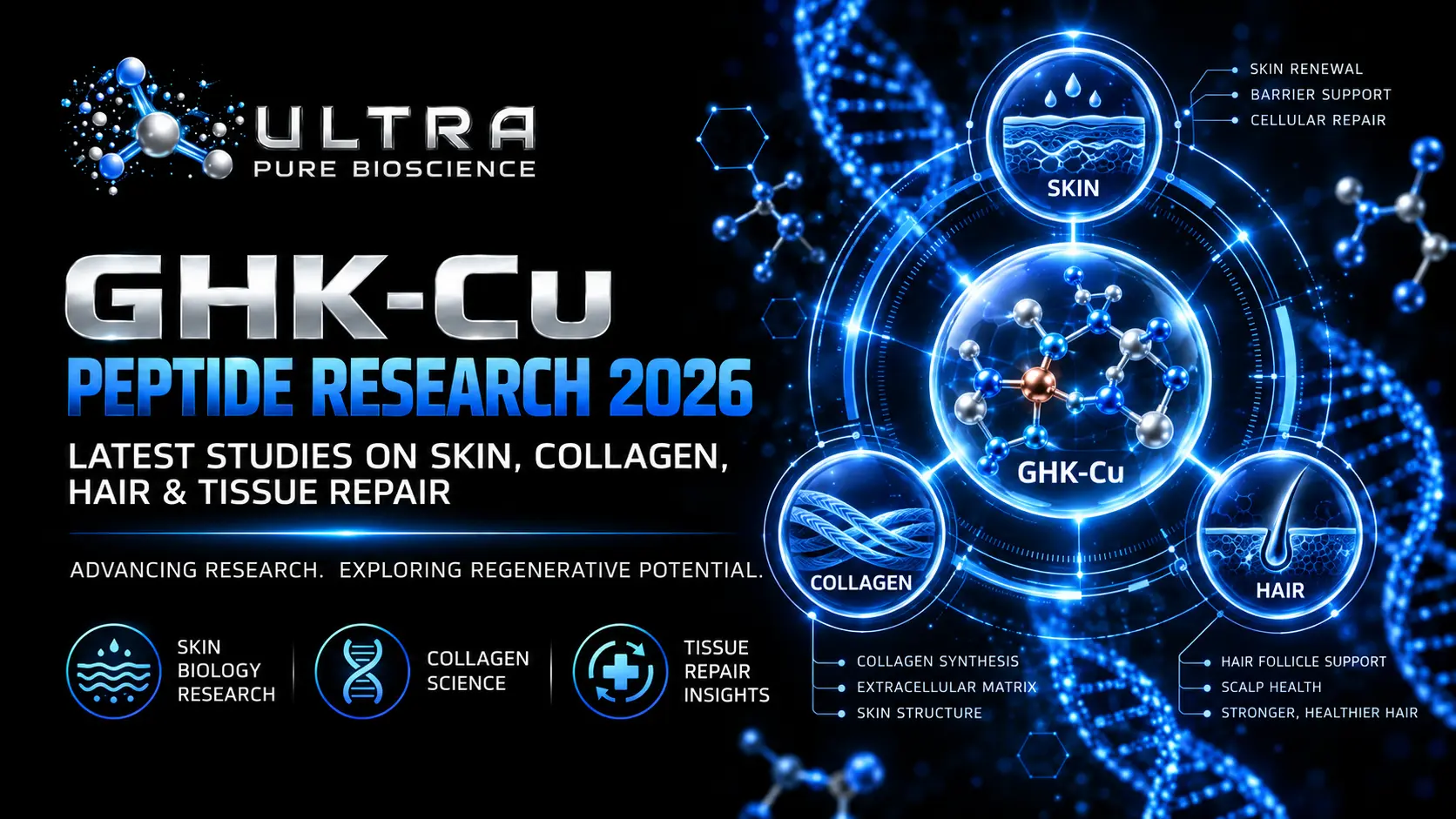
GHK Cu Peptide Research has become an important area of modern peptide science. Researchers study GHK-Cu because of its links to copper binding, collagen activity, skin biology, tissue repair, and extracellular matrix signaling.
Interest has grown further in 2026. New scientific reviews now give researchers a clearer picture of both the strengths and limits of the available evidence. Most published findings still come from laboratory and preclinical studies. Therefore, scientists must separate promising biological findings from proven human outcomes.
A systematic review published in Aesthetic Surgery Journal on August 20, 2026 included 20 eligible GHK-Cu studies. Eighteen were preclinical studies, while only two were randomized controlled trials. The review found consistent preclinical effects involving collagen, glycosaminoglycans, angiogenesis, cell growth, inflammatory signaling, and extracellular matrix activity. However, the authors also stressed the need for larger and better controlled clinical trials.
This GHK Cu Peptide Research review examines what GHK-Cu is, how scientists study it, and what current research says about collagen, skin biology, tissue repair, hair, safety, and clinical evidence.
Research Notice: This article is provided for scientific and educational purposes only. Ultra Pure Bioscience research materials are intended strictly for laboratory and analytical research. They are not intended for human or veterinary use, diagnosis, treatment, or prevention of disease.
GHK Cu Peptide Research: What Is GHK-Cu?
GHK-Cu is a copper-binding peptide complex.
GHK stands for glycyl-L-histidyl-L-lysine. The peptide contains three amino acids:
- Glycine
- Histidine
- Lysine
GHK can bind copper ions. Once copper binds to the peptide, researchers commonly call the complex GHK-Cu.
PubChem lists GHK-Cu as a copper tripeptide and identifies glycyl-L-histidyl-L-lysine as its parent peptide.
Copper plays several roles in normal cell biology. In addition, many enzymes depend on copper for their activity.
Because GHK can bind copper, researchers study the complex as both a copper carrier and a signaling molecule.
Why GHK Cu Peptide Research Matters in 2026
GHK Cu Peptide Research matters in 2026 because scientists now have enough published evidence to compare different research areas more carefully.
Some areas have a strong laboratory foundation.
Others still have limited human data.
The newest systematic review searched PubMed, Embase, and Cochrane CENTRAL through March 2026. The researchers found 20 eligible studies. However, only two were randomized controlled trials.
That difference is important.
A strong result in cells or animals does not automatically prove the same result in humans.
Therefore, one of the main goals of current GHK-Cu research is to close the gap between promising laboratory findings and well-controlled clinical evidence.
How Does GHK-Cu Work?
Researchers have proposed several ways that GHK-Cu may affect biological systems.
First, GHK binds copper.
Next, the complex may influence cell signals linked to connective tissue, repair, inflammation, and extracellular matrix activity.
Researchers have studied GHK-Cu in relation to:
- collagen synthesis,
- fibroblast activity,
- glycosaminoglycans,
- extracellular matrix remodeling,
- angiogenesis,
- oxidative stress,
- inflammatory signaling,
- cell proliferation,
- and gene expression.
However, no single pathway explains every reported effect.
Instead, GHK-Cu appears to interact with several linked biological processes.
GHK Cu Peptide Research and Collagen
Collagen is one of the most studied areas of GHK Cu Peptide Research.
Fibroblasts produce much of the collagen found in connective tissue.
Preclinical studies have reported changes in fibroblast activity and collagen synthesis after exposure to GHK-Cu.
The 2026 systematic review found that preclinical studies consistently reported increased type I collagen and glycosaminoglycan synthesis. Researchers also observed changes in enzymes involved in extracellular matrix remodeling.
These findings help explain why GHK-Cu remains important in connective-tissue research.
However, laboratory results need careful interpretation.
Concentration can affect the outcome.
Formulation can also matter.
In addition, delivery method and tissue type may change how a peptide behaves.
Therefore, a collagen result from a laboratory model does not automatically prove the same effect in humans.
GHK Cu Peptide Research and Skin Biology
GHK Cu Peptide Research has a long history in skin and extracellular matrix science.
Researchers have studied the peptide complex in fibroblasts, keratinocytes, tissue models, animal models, and limited human studies.
Major research areas include:
- collagen biology,
- skin structure,
- extracellular matrix activity,
- cell growth,
- oxidative stress,
- inflammatory signaling,
- angiogenesis,
- and tissue remodeling.
The 2026 systematic review found a reasonable biological basis for GHK-Cu research in aesthetic and regenerative science. However, the review also noted that clinical evidence remains much smaller than the preclinical evidence.
This distinction matters.
Researchers may see strong biological activity in a laboratory setting while still needing better human trials to confirm the clinical importance of those findings.
GHK-Cu and the Extracellular Matrix
The extracellular matrix surrounds cells and helps support tissue structure.
It contains several important components, including:
- collagen,
- elastin,
- glycosaminoglycans,
- proteoglycans,
- and other structural proteins.
GHK-Cu studies have examined several parts of this system.
Researchers have reported changes in collagen and glycosaminoglycan production.
They have also studied matrix metalloproteinases, commonly called MMPs.
MMPs help break down and remodel extracellular matrix proteins.
Therefore, tissue health depends on a balance between building new matrix and breaking down older material.
GHK-Cu remains interesting because researchers have observed effects on both sides of this remodeling process.
What Did the 2026 GHK-Cu Systematic Review Find?
The August 2026 systematic review is one of the most important recent additions to the GHK-Cu evidence base.
Researchers reviewed 20 studies.
Of those:
18 were preclinical studies.
2 were randomized controlled trials.
The preclinical studies reported effects involving:
- type I collagen,
- glycosaminoglycans,
- metalloproteinase activity,
- angiogenesis,
- cellular proliferation,
- transforming growth factor-beta,
- and interleukin-6 signaling.
The review also reported some positive clinical findings involving skin-related outcomes.
However, the authors identified several limitations.
Study methods differed.
Researchers also used different formulations and delivery methods.
In addition, the number of high-quality human trials remained small.
For these reasons, the authors called for larger controlled trials with more standardized formulations and study methods.
GHK Cu Peptide Research and Tissue Repair
Tissue repair is another major area of GHK Cu Peptide Research.
Scientists have studied GHK-Cu in models involving wound repair, fibroblast activity, new blood-vessel formation, and extracellular matrix remodeling.
Several biological processes may be involved.
Fibroblasts help produce connective tissue.
Meanwhile, angiogenesis creates new blood vessels.
Matrix remodeling also helps damaged tissue reorganize structural proteins.
Older research reviews have described GHK and GHK-Cu activity across several of these repair-related pathways.
However, much of the evidence comes from preclinical models.
Therefore, researchers should not assume that every laboratory result will translate directly to humans.
GHK-Cu and Angiogenesis Research
Angiogenesis means the formation of new blood vessels.
It plays an important role in tissue repair and normal biology.
Researchers have observed angiogenesis-related activity in several GHK-Cu studies.
The 2026 systematic review also identified angiogenesis as one of the areas with consistent preclinical findings.
However, more angiogenesis is not automatically beneficial in every biological setting.
The effect depends on the tissue and research model.
Therefore, scientists must interpret these findings in context.
GHK-Cu and Inflammatory Signaling
Inflammation is part of the body’s normal response to injury and biological stress.
However, excessive or prolonged inflammation may interfere with normal repair.
Researchers have studied whether GHK-Cu changes inflammatory signaling.
The 2026 systematic review reported preclinical effects involving transforming growth factor-beta and interleukin-6 pathways.
These findings may help scientists understand how GHK-Cu interacts with tissue-remodeling pathways.
However, these results do not prove that GHK-Cu treats inflammatory disease in humans.
Dedicated clinical studies would be needed to answer that question.
GHK-Cu and Oxidative Stress Research
Oxidative stress occurs when reactive molecules build up faster than cells can control them.
High oxidative stress may damage proteins, lipids, and DNA.
Researchers have studied GHK-Cu in several oxidative-stress models.
The 2026 systematic review describes antioxidant activity among the preclinical findings reported for GHK-Cu.
This creates another area for future research.
Scientists still need to determine how these findings differ between tissues, formulations, and experimental conditions.
GHK-Cu and Gene Expression
Gene expression is another area of GHK-Cu research.
Researchers have studied how GHK and its copper complex may affect genes linked to:
- tissue repair,
- extracellular matrix activity,
- inflammatory signaling,
- antioxidant systems,
- and cell growth.
However, gene-expression findings require careful interpretation.
A change in gene activity does not automatically mean that a compound reverses aging or repairs human tissue.
Instead, gene-expression studies help researchers identify possible biological mechanisms.
Scientists can then test those mechanisms in more controlled studies.
GHK-Cu Hair Research
Hair biology is one of the most searched topics related to copper peptides.
However, the evidence needs careful interpretation.
One often-cited 2007 study examined a copper tripeptide in human hair follicles. Importantly, the study tested AHK-Cu, not GHK-Cu. Researchers observed increased follicle elongation and dermal papilla cell activity in laboratory conditions.
This distinction matters because AHK-Cu and GHK-Cu are different peptides.
Another human trial studied a combination of GHK peptide with 5-aminolevulinic acid rather than GHK-Cu alone. The study reported changes in hair count, but the combined formulation makes it difficult to assign the result specifically to GHK.
Therefore, the current evidence does not justify treating every copper-peptide hair study as direct proof for GHK-Cu.
Hair research remains an interesting field, but dedicated GHK-Cu human studies are still needed.
GHK-Cu vs AHK-Cu
GHK-Cu and AHK-Cu are related copper-binding peptides.
However, their amino-acid sequences differ.
GHK contains:
Glycine – Histidine – Lysine
AHK contains a different sequence.
As a result, researchers should not automatically apply findings from one peptide to the other.
This is especially important when reading hair-growth research.
The 2007 human hair follicle experiment, for example, specifically tested AHK-Cu.
GHK-Cu and Copper Tripeptide
PubChem lists GHK-Cu as a copper tripeptide complex and identifies GHK as the parent peptide.
The terms GHK-Cu, copper tripeptide, and related cosmetic terminology may appear across different databases and product labels.
However, researchers should still document the exact material used in an experiment.
Important factors include:
- identity,
- purity,
- copper coordination,
- storage conditions,
- batch data,
- and analytical methods.
These details can affect laboratory results.
Why Delivery Method Matters
Peptide delivery can affect research outcomes.
Peptides may have difficulty crossing biological barriers.
This issue is especially important in skin research.
Researchers have explored delivery systems such as:
- liposomes,
- microneedles,
- hydrogels,
- and other carriers.
The 2026 systematic review noted that advanced delivery systems, including microneedles and liposomes, improved transdermal delivery in the studies it evaluated.
Therefore, scientists should not assume that results from one formulation apply to every other formulation.
Delivery method is part of the experiment.
Current Limits of GHK Cu Peptide Research
Current Limits of GHK Cu Peptide Research are important to understand because the laboratory literature is much larger than the human clinical literature.
The 2026 review included 18 preclinical studies but only two randomized controlled trials.
That means researchers still need more information about:
- long-term outcomes,
- optimal formulations,
- delivery methods,
- reproducibility,
- clinical safety,
- and effects across different study populations.
Researchers also need more standardized protocols.
Without standard methods, it becomes harder to compare one study with another.
Therefore, current evidence supports continued research rather than broad clinical claims.
Is GHK-Cu FDA Approved?
The phrase FDA approved needs careful use.
In the United States, cosmetic ingredients generally do not require FDA premarket approval, except for certain color additives. Therefore, the presence of a copper peptide in a cosmetic product does not mean that the FDA has approved GHK-Cu as a drug or medical treatment.
The FDA also states that claims to treat disease or affect the structure or function of the body may cause a product to fall under drug rules rather than cosmetic rules.
For laboratory research materials, researchers should follow applicable institutional and regulatory requirements.
How Strong Is the Current Evidence?
Current GHK-Cu evidence varies by research area.
| Research Area | Current Evidence |
|---|---|
| Copper binding | Well characterized |
| Fibroblast activity | Strong preclinical evidence |
| Collagen research | Strong preclinical evidence |
| Extracellular matrix | Strong preclinical evidence |
| Angiogenesis | Mainly preclinical |
| Tissue repair | Strong preclinical, limited human evidence |
| Inflammatory signaling | Mainly preclinical |
| Oxidative stress | Mainly preclinical |
| Skin outcomes | Limited human evidence |
| Hair research | Mixed and indirect evidence |
| Gene expression | Mechanistic research |
| Systemic outcomes | Limited human evidence |
The 2026 systematic review supports this overall picture.
GHK-Cu has a meaningful biological research record.
However, the human clinical evidence remains much smaller than the laboratory evidence.
Research Peptides and Laboratory Quality
Reliable peptide research requires more than a compound name.
Researchers should consider:
- analytical purity,
- material identity,
- batch traceability,
- storage conditions,
- test methods,
- and research documentation.
Ultra Pure Bioscience provides research peptides for laboratory, analytical, and scientific research.
Add your internal link to the words research peptides:
https://ultrapurebioscience.org/peptides/
Research materials should be handled only within appropriate laboratory settings.
Ultra Pure Bioscience products are not intended for human or veterinary use.
Future of GHK Cu Peptide Research
The future of GHK Cu Peptide Research will likely focus on stronger human evidence.
Researchers already have a large body of laboratory data.
The next step is better clinical translation.
Future studies should use larger participant groups.
They should also report exact formulations and delivery methods.
In addition, researchers need consistent outcome measures.
These changes would make different studies easier to compare.
The 2026 systematic review reached a similar conclusion. Its authors called for larger controlled trials with standardized formulations, dosing approaches, and delivery methods.
GHK-Cu Research 2026: Key Takeaways
Overall, GHK Cu Peptide Research continues to support scientific interest in copper binding, collagen signaling, fibroblast biology, tissue repair, and extracellular matrix activity.
Current evidence shows that:
- GHK-Cu is a copper-binding tripeptide complex.
- Collagen and extracellular matrix studies have a strong preclinical foundation.
- Tissue-repair and angiogenesis findings remain largely preclinical.
- Human clinical evidence is much smaller than the laboratory literature.
- The newest 2026 systematic review included 20 studies, but only two were randomized controlled trials.
- Some popular hair research involves AHK-Cu or combination formulations rather than GHK-Cu alone.
- Better standardized human studies are still needed.
Therefore, GHK-Cu remains an active and scientifically interesting research area in 2026.
Frequently Asked Questions
What is GHK Cu Peptide Research?
GHK Cu Peptide Research examines GHK-Cu and its interactions with copper binding, collagen, fibroblasts, extracellular matrix activity, skin biology, tissue repair, and related cell pathways.
What is GHK-Cu?
GHK-Cu is a complex formed when the tripeptide glycyl-L-histidyl-L-lysine binds copper.
What does GHK mean?
GHK stands for glycine, histidine, and lysine.
These are the three amino acids that form the peptide.
What is GHK-Cu studied for?
Researchers study GHK-Cu in collagen biology, fibroblast activity, extracellular matrix remodeling, angiogenesis, inflammation, oxidative stress, tissue repair, skin biology, and gene expression.
Does GHK-Cu affect collagen?
Preclinical research has reported changes in collagen and extracellular matrix activity.
However, laboratory findings do not automatically prove the same outcome in humans.
Is GHK-Cu proven for hair growth?
Current evidence is less direct than many online claims suggest.
A frequently cited hair-follicle experiment studied AHK-Cu rather than GHK-Cu. Another human study used GHK as part of a combination product.
What did the 2026 GHK-Cu review find?
The systematic review included 20 studies. Eighteen were preclinical studies and two were randomized controlled trials.
Researchers found a reasonable biological basis for continued study, but they also highlighted the need for larger and more standardized human trials.
Is GHK-Cu FDA approved?
GHK-Cu should not broadly be described as an FDA-approved medical treatment.
Cosmetic ingredients generally do not receive FDA premarket approval, except for certain color additives.
Scientific References
Mokhtar J, Mohamed B, Haddad J, et al.
The Regenerative Potential of Glycyl-L-Histidyl-L-Lysine–Copper in Aesthetic Medicine.
Aesthetic Surgery Journal. Published August 20, 2026. The review included 20 studies, including 18 preclinical studies and two randomized controlled trials.
Pyo HK, Yoo HG, Won CH, et al.
The Effect of Tripeptide-Copper Complex on Human Hair Growth In Vitro.
Archives of Pharmacal Research. 2007. The study tested AHK-Cu rather than GHK-Cu.
Lee WJ, Sim HB, Jang YH, et al.
Efficacy of a Complex of 5-Aminolevulinic Acid and Glycyl-Histidyl-Lysine Peptide on Hair Growth.
Annals of Dermatology. 2016.
National Library of Medicine — PubChem.
Copper tripeptide / GHK-Cu chemical identity information.
U.S. Food and Drug Administration.
Cosmetic ingredient and labeling guidance.